

Understanding Wildfire Behavior: How Communities Can Read Fire Reports and Recognize When a Fire Shifts from DC to AC

Wildfire conversations often create fear because people don’t know how to interpret fire reports. They hear “a wildfire is burning,” and imagine runaway flames, evacuations, and destruction — even when the fire is actually contained, predictable, and safe.
FieldSpan’s terrain‑aware wildfire intelligence framework helps communities understand what’s really happening by distinguishing between two types of fire behavior:
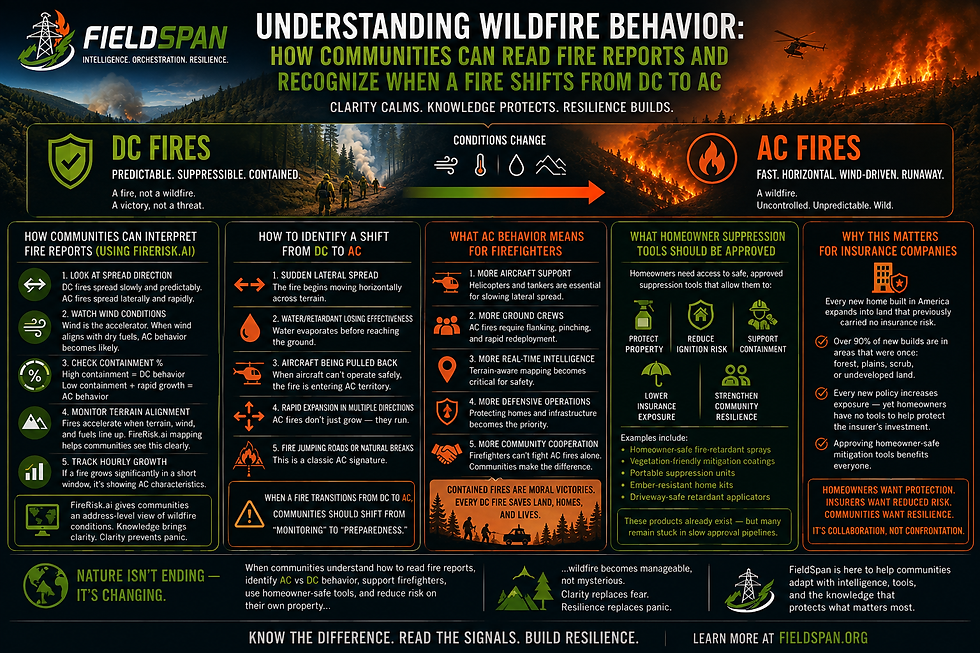
DC Fires — predictable, suppressible, contained
AC Fires — fast, horizontal, wind‑driven, runaway
This distinction is not just technical. It’s emotional. It’s practical. It’s calming.
When communities understand the difference, wildfire becomes less frightening and far easier to interpret.
How Communities Can Interpret Fire Reports (Using FireRisk.ai)
FireRisk.ai gives homeowners and communities a clear, address‑level view of wildfire conditions. But the real value comes from knowing how to read what the system is showing.
Here’s how communities can use FireRisk.ai to understand fire behavior:
1. Look at the spread direction
DC fires spread slowly and predictably.
AC fires spread laterally, rapidly, and often against expectations.
2. Watch the wind conditions
Wind is the accelerator. When wind aligns with dry fuels, AC behavior becomes likely.
3. Check containment percentages
High containment = DC behavior
Low containment + rapid growth = AC behavior
4. Monitor terrain alignment
Fires accelerate when terrain, wind, and fuels line up. FireRisk.ai’s mapping helps communities see this clearly.
5. Track hourly growth
If a fire grows significantly in a short window, it’s showing AC characteristics.
FireRisk.ai becomes the community’s wildfire dashboard, helping people understand what’s happening without panic.
How to Identify When a Fire Shifts from DC to AC
A fire can begin as DC — predictable and suppressible — and then shift into AC behavior when conditions change.
Communities should watch for these signs:
1. Sudden lateral spread
If the fire begins moving horizontally across terrain, that’s AC behavior.
2. Water and retardant losing effectiveness
When water evaporates before reaching the ground, suppression becomes difficult.
3. Aircraft being pulled back
If aircraft operations become unsafe, the fire is entering AC territory.
4. Rapid expansion in multiple directions
AC fires don’t just grow — they run.
5. Fire jumping roads or natural breaks
This is a classic AC signature.
When a fire transitions from DC to AC, communities should shift from “monitoring” to “preparedness.”
What AC Behavior Means for Firefighters
When a fire becomes AC, firefighters need:
1. More aircraft support
Helicopters and tankers become essential for slowing lateral spread.
2. More ground crews
AC fires require flanking, pinching, and rapid redeployment.
3. More real‑time intelligence
Terrain‑aware mapping becomes critical for safety.
4. More defensive operations
Protecting homes and infrastructure becomes the priority.
5. More community cooperation
Firefighters cannot fight AC fires alone. They need homeowners to understand the risk and prepare accordingly.
What Homeowner Suppression Tools Should Be Approved
Homeowners need access to safe, approved suppression tools that allow them to:
protect their property
reduce ignition risk
support containment efforts
lower insurance exposure
strengthen community resilience
These tools might include:
homeowner‑safe fire‑retardant sprays
vegetation‑friendly mitigation coatings
portable suppression units
ember‑resistant home kits
driveway‑safe retardant applicators
These products already exist — but many remain stuck in slow approval pipelines.
Approving homeowner‑safe mitigation tools is not just good policy. It’s good economics.
Why This Matters for Insurance companies
Every new home built in America expands into land that previously carried no insurance risk.
Over 90% of new builds are in areas that were once:
forest
plains
scrub
undeveloped land
Every new policy increases exposure. Yet homeowners are given no suppression tools to help protect the insurer’s investment.
That’s the gap.
And homeowner‑safe mitigation products fill it.
This is not confrontation. It’s collaboration.
Homeowners want protection. Insurers want reduced risk. Communities want resilience.
Approving homeowner‑safe mitigation tools benefits everyone.
Nature Isn’t Ending — It’s Changing
Wildfire behavior is evolving. Communities are expanding. Terrain is shifting. Weather patterns are intensifying.
But fear doesn’t help. Clarity does.
When communities understand:
how to read fire reports
how to identify AC vs DC behavior
how to support firefighters
how to use homeowner‑safe suppression tools
how to reduce risk on their own property
…wildfire becomes manageable, not mysterious.
Nature isn’t ending. Nature is changing. And FieldSpan is here to help communities adapt with clarity, not panic.


Comments