

How the AC/DC Grid Shift Could Affect Your Monthly Electric Bill

How the AC/DC Grid Shift Protects Your Monthly Bill
Most people don’t know the grid is changing. But everyone knows their bill is going up.
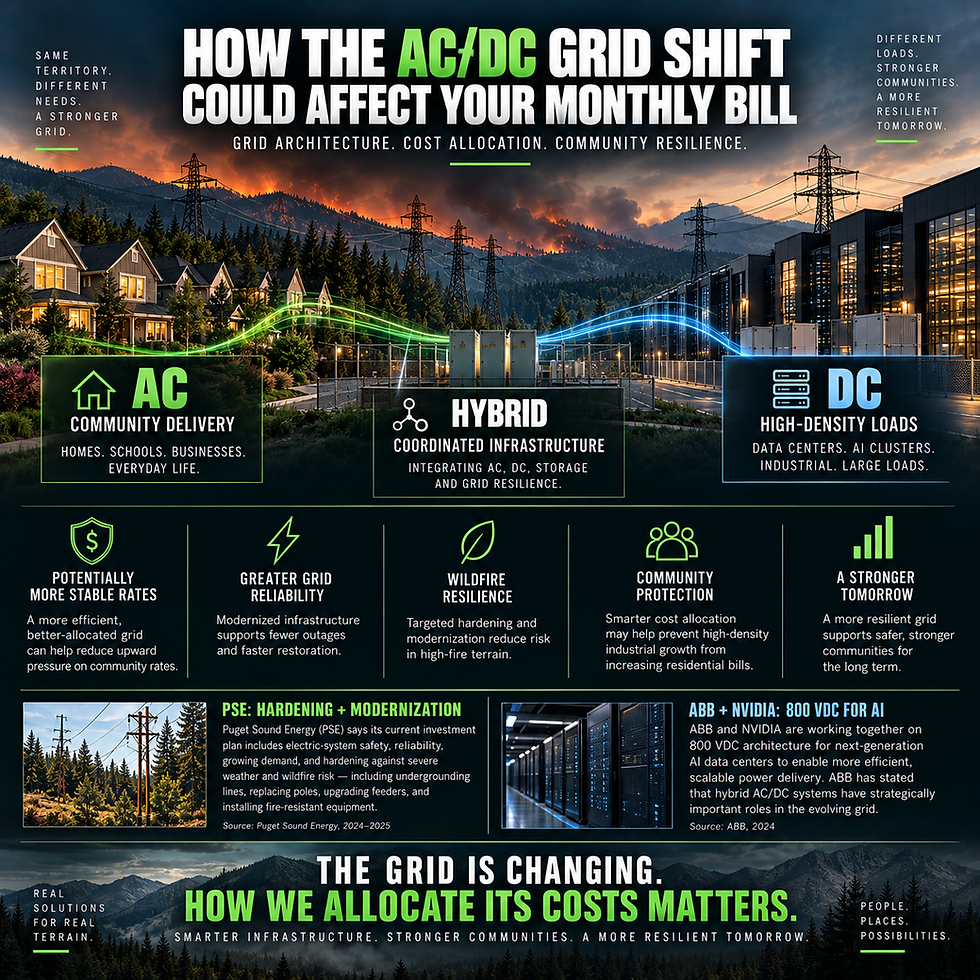
Puget Sound Energy is hardening its system right now — undergrounding lines, replacing poles, upgrading feeders, adding fire‑resistant equipment. And every time a utility announces a hardening project, the public braces for another rate increase.
Because for the average Joe, the only number that matters is cost per kWh. It’s the number that determines whether a family can stay afloat.
Here’s the part nobody explains:
The AC/DC shift is actually designed to protect your bill.
Large‑scale industry — data centers, AI clusters, battery‑heavy operations — is moving to DC because it’s more efficient for high‑demand loads.
But here’s the key:
DC load users pay for DC upgrades. AC communities pay for AC upgrades.
That means:
industrial growth doesn’t raise residential bills
data‑center expansion doesn’t spill into neighborhood rates
AI clusters don’t force AC system upgrades
wildfire‑hardening costs stay on the AC side
DC users fund their own reliability and efficiency
Hybrid grids separate the costs so communities aren’t subsidizing industrial growth.
This is how you protect the average Joe.
You may never see the AC/DC shift. You may never hear about the ABB announcement. You may never think about converters or hybrid nodes.
But you will feel the impact:
fewer outages
faster restoration
better fire‑season stability
less grid stress during heat waves
more predictable bills
The grid is changing. Your rates don’t have to.


Comments