

The Four Seasons of Wildfire: Why Homeowners Need Safe Mitigation Tools Now — Not Years From Now

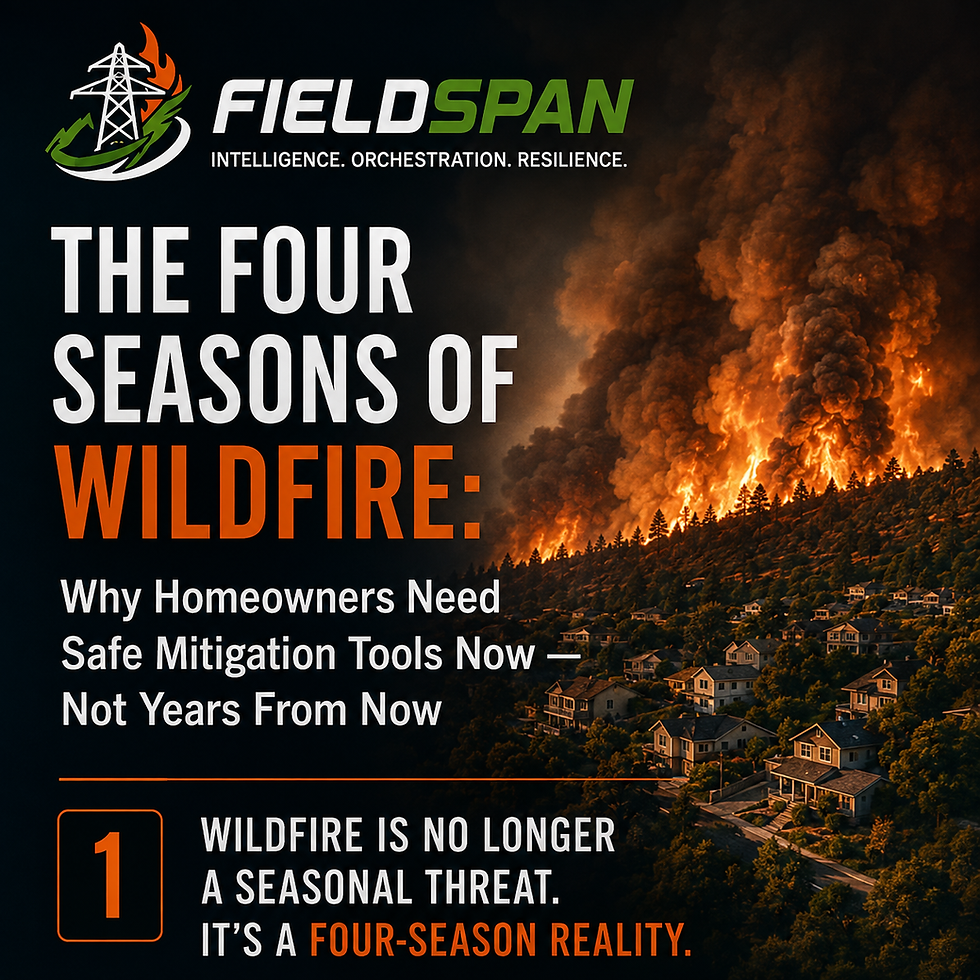
Wildfire used to be a seasonal threat. Now it’s a four‑season reality — and the fires we’ve seen this year prove it.
We watched wildfires burn:
forests
high plains
agricultural corridors
entire neighborhoods
When fire behavior crosses terrain types this easily, communities need tools that match the reality — not the pace of a slow approval pipeline.
FieldSpan’s terrain‑aware analysis breaks the year into four operational seasons.
1. Winter — The Quiet Season That Isn’t Quiet
Winter used to be the reset period. Now it’s the risk accumulation period.
dormant fuels
long‑term drought
warm anomalies
winter wind events
States like Florida, Oklahoma, and Texas have already seen winter fires that behave like spring events.
Winter is no longer “safe.” It’s the foundation for the rest of the year.
2. Spring — The Wind Season
Spring winds turn small ignitions into fast‑moving threats.
Even when vegetation is still wet, wind:
dries fuels rapidly
pushes flames across terrain
overwhelms initial attack
creates long‑distance spotting
This is the season where utility corridors, access routes, and rapid response matter most.
3. Summer — The Fuel Season
Summer is when everything dries out.
vegetation becomes tinder
heat accelerates ignition
terrain dictates fire behavior
communities face their highest exposure
This is where terrain intelligence becomes non‑negotiable. Fires don’t behave randomly — they behave according to slope, wind, fuel, and access.
4. Fall — The Transition Season
Historically the worst.
dry fuels
strong winds
human activity
unstable weather patterns
Fall fires are often the most destructive because they combine summer fuels with spring winds.
This is the season where communities need:
home hardening
defensible space
homeowner‑safe mitigation coatings
evacuation readiness
utility coordination
Climate Patterns: What’s Coming Next
Across the West, Southwest, and Southeast, we’re seeing:
longer dry periods
shorter recovery windows
more nighttime fire behavior
more wind‑driven events
more regions experiencing “first‑time” wildfires
This isn’t fear‑based commentary. It’s operational reality.
Wildfire is no longer a climate story — it’s a safety story.


Comments