

AC Fire Behavior as Weather: A Terrain‑Aware Model for Leaders Across Industries

Every once in a while, a single comment crystallizes a concept you’ve been building quietly in the background. That happened this morning when Dan Maher, a Healthcare Cost Strategist, responded to one of our wildfire posts with a line that captured the heart of FieldSpan’s doctrine:
“The way you frame AC fire behavior as ‘weather’ is a useful shift for leaders.”
He’s right. And that insight opens the door to something bigger than wildfire.
AC Fire Behavior Isn’t Just Fire — It’s Weather
When a fire enters AC behavior, it stops acting like a flame and starts acting like a weather system:
fast
horizontal
wind‑driven
terrain‑accelerated
capable of compressing decision timelines
Plans built for slow, predictable growth fail quickly under AC conditions. This is true in wildfire — and it’s true in any industry facing fast‑moving pressure.
AC behavior is acceleration, not combustion.
It’s the moment where leaders must shift from planning to maneuvering.
DC Fire Behavior Is Terrain — Predictable, Contained, and Tactical
A DC fire behaves like terrain:
stable
flankable
suppressible
predictable
manageable
DC conditions reward structured planning. They allow firefighters to flank, pinch, and contain. They allow communities to prepare calmly.
A DC fire is not a wildfire. It is a moral victory — a demonstration of control, coordination, and resilience.
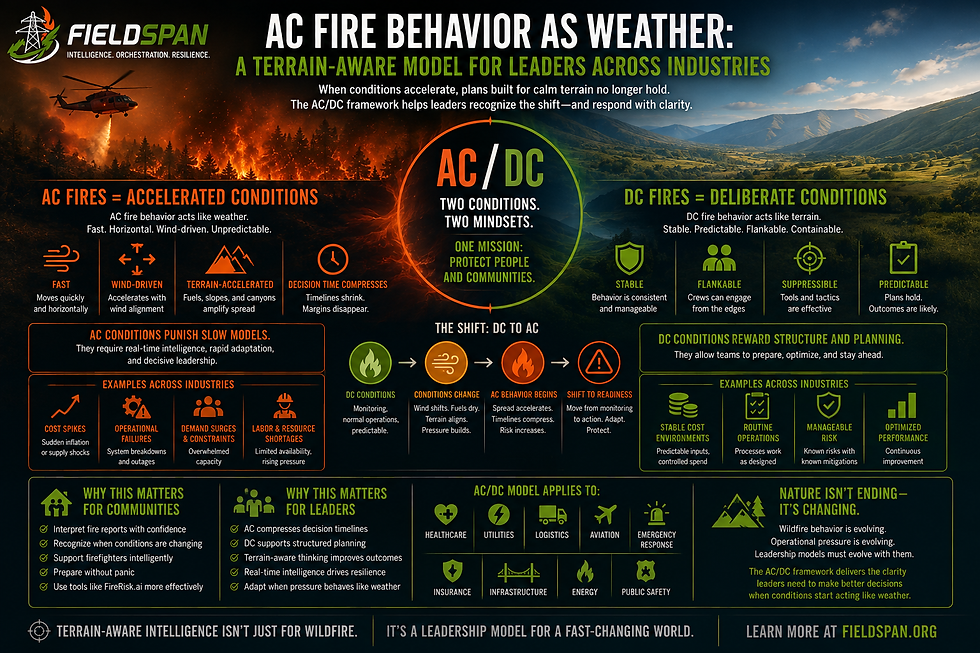
The Cross‑Industry AC/DC Model
Dan’s comment revealed something important:
The AC/DC wildfire framework is actually a cross‑industry decision‑pressure model.
AC = Accelerated Conditions
Fast‑moving pressure that behaves like weather.
In wildfire: wind‑driven spread, explosive lateral movement.
In other industries: cost spikes, operational failures, cascading strain, demand surges and labor constraints.
AC conditions compress decision timelines. They punish slow models. They require real‑time intelligence and rapid adaptation.
DC = Deliberate Conditions
Predictable pressure that behaves like terrain.
In wildfire: contained fires, prescribed burns, slow growth.
In other industries: stable cost environments, routine operations, manageable risk.
DC conditions reward structure, planning, and optimization.
Why This Matters for Communities
Understanding AC vs DC behavior helps communities:
interpret fire reports
understand when conditions are changing
support firefighters intelligently
prepare without panic
use tools like FireRisk.ai more effectively
When a fire shifts from DC to AC, communities should shift from monitoring to readiness.
When a fire remains DC, communities can stay calm and informed.
This is how we reduce fear and increase clarity.
Why This Matters for Leaders in Any Field
Dan Maher saw it immediately:
AC behavior compresses decision timelines. DC behavior supports structured planning.
This applies to:
healthcare
utilities
logistics
aviation
emergency response
insurance
infrastructure
energy
public safety
Terrain‑aware thinking helps leaders adapt when conditions accelerate.
Nature Isn’t Ending — It’s Changing
Wildfire behavior is evolving. Operational pressure is evolving. Leadership models must evolve with them.
The AC/DC framework gives communities and leaders a way to understand pressure without fear — and respond with clarity instead of panic.
This Saturday feature is the beginning of a broader conversation:
Terrain‑aware intelligence isn’t just for wildfire. It’s a leadership model for a fast‑changing world.


Comments