

AC/DC Wildfire Behavior: Why 51,774 Fires Don’t Tell the Real Story — And Why Travel Routes Now Matter

The U.S. has recorded 51,774 wildfires so far this year. It’s a big number — but it hides the only distinction that actually matters for homeowners, utilities, and anyone who moves across the country:
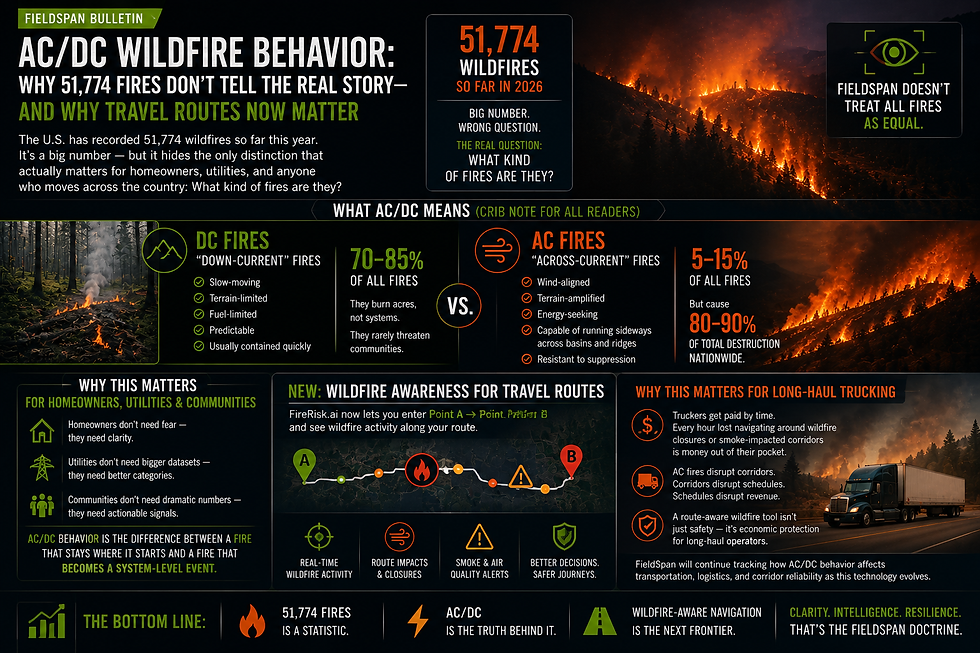
What kind of fires are they?
Most wildfire reporting treats all fires as equal. FieldSpan doesn’t.
To understand the 2026 season, you need a simple behavioral lens: AC fires vs DC fires.
What AC/DC Means (Crib Note for All Readers)
DC Fires — “Down‑Current” Fires
These are the fires most people imagine:
slow‑moving
terrain‑limited
fuel‑limited
predictable
usually contained quickly
They burn acres, not systems. They rarely threaten communities. They make up 70–85% of all fires.
AC Fires — “Across‑Current” Fires
These are the fires that define the modern era:
wind‑aligned
terrain‑amplified
energy‑seeking
capable of running sideways across basins and ridges
resistant to suppression
They make up only 5–15% of fires — but cause 80–90% of total destruction nationwide.
This is the real story of 2026: A small minority of fires are driving nearly all the impact.
Why This Matters for Homeowners and Utilities
Homeowners don’t need fear — they need clarity. Utilities don’t need bigger datasets — they need better categories. Communities don’t need dramatic numbers — they need actionable signals.
AC/DC behavior is the difference between a fire that stays where it starts and a fire that becomes a system‑level event.
FieldSpan’s doctrine is built to make that difference visible.
New: Wildfire Awareness for Travel Routes
Last night, FireRisk.ai announced a new feature: You can now enter Point A → Point B and see wildfire activity along your route.
This is more than a convenience tool — it’s a logistics signal.
Why This Matters for Long‑Haul Trucking
Truckers get paid by time. Every hour lost navigating around wildfire closures or smoke‑impacted corridors is money out of their pocket.
Until now, wildfire intelligence has been built for homeowners and emergency managers. This is the first step toward real‑time wildfire‑aware navigation for the people who move America’s freight.
And here’s the strategic layer:
AC fires disrupt corridors.
Corridors disrupt schedules.
Schedules disrupt revenue.
A route‑aware wildfire tool isn’t just safety — it’s economic protection for long‑haul operators.
FieldSpan will continue tracking how AC/DC wildfire behavior affects transportation, logistics, and corridor reliability as this technology evolves.
The Bottom Line
51,774 fires is a statistic. AC/DC is the truth behind it. And wildfire‑aware navigation is the next frontier.


Comments